
Every apparel order has a moment of truth, and it is not the logo proof. It is the day the boxes open and the whole team tries their gear on. Get sizing right and the apparel disappears onto backs and shoulders by lunchtime. Get it wrong and a stack of unworn mediums haunts a supply closet for years.
Sizing feels like guesswork, but it is really just process. Teams that follow a few unglamorous steps hit near perfect fit rates on orders of ten or a thousand, and teams that wing it fund the donation bin. Here is the playbook.
How do you get sizing right on a team apparel order?
Collect real sizes from every person with a simple form instead of guessing a distribution, check the size chart for the exact garment since every brand cuts differently, offer a full size range including extended sizes, and add 5 to 10 percent extras in the middle sizes to cover new hires and mistakes.
The theme across all four steps is the same: measured beats assumed. Nearly every sizing disaster starts with someone estimating what a team probably wears, and nearly every clean order starts with a two minute form. The rest of this guide turns those four steps into habits.
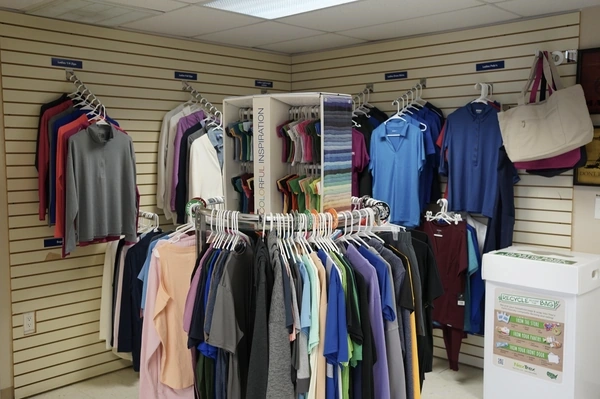
Collect sizes; never guess the curve
The standard size curve, that small through 2XL bell shape suppliers suggest when you have nothing better, describes an average team that does not actually exist. Your roster skews however it skews, and a guessed curve reliably strands the wrong sizes in a box while three people wait on a reorder. A short form asking for name and size per garment outperforms every estimate ever made.
Make the form specific. Asking for “your size in this exact tee” with a product link pulls better data than “shirt size”, because people answer from the garments they already own. For hoodies, jackets, and anything worn over other clothing, remind the team that many people size up in layers. Set a deadline, chase stragglers once, and give anyone silent the size from the last order rather than holding up production.
Size charts: a large is not a large
Brands cut differently, and the gap is wider than most buyers expect. A large in a slim retail fashion cut can measure close to a medium in a classic work shirt, and the same brand often cuts its tees and its polos on different blocks. Professional orders check the actual chart, chest width and body length for the specific style number, before anyone commits money.
Put the chart to work inside your sizing form. Asking everyone to lay a favorite shirt flat and measure armpit to armpit takes thirty seconds and maps directly onto any chart in the industry. And when an order mixes cuts, publish each chart separately, because a unisex large and a women’s large are entirely different garments and treating them as one is how orders go sideways.
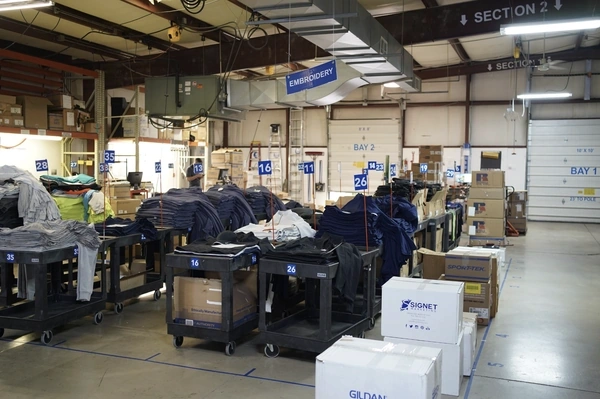
Fit styles that work for a whole team
Unisex classic cuts fit the most bodies with the fewest complaints, which is why they anchor most successful programs. Slim fashion cuts photograph beautifully and alienate half the roster. When the budget allows it, offering both a unisex and a women’s cut of the same style in the same color raises wear rates noticeably, and modern apparel lines make matching colors across cuts easy.
Extend the size range before anyone has to ask for it. Stocking XS through 3XL or 4XL, plus tall sizes where the line offers them, adds little to the invoice and pays it back in a team where every single person got gear that fits. Nothing undercuts an apparel rollout faster than one teammate quietly left out of it.
Samples, extras, and the long game
For a first order in an unfamiliar style, buy a small sample run, perhaps a medium, a large, and an XL, and let a few different builds try them on before the full commitment. Twenty dollars of samples has rescued thousands of dollars of orders more times than anyone in this industry can count.
Then pad the final order by 5 to 10 percent, weighted toward medium, large, and XL. Extras cover new hires, decoration casualties, and the coworker whose form answer turned out to be optimistic. Finally, keep a size log from every order. Reorders shrink from a project into a single email when someone kept the records, and that log doubles as a cheat sheet for onboarding kits later.
Bottom Line
Great fitting team apparel comes from collected sizes, checked charts, inclusive ranges, and a cushion of extras, never from luck. The process costs a week on the front end and repays it every day the gear actually gets worn. Signet Marketing builds sizing forms, sample runs, and size logs into every apparel program we manage, so orders fit right the first time. Planning a team order? Send us the roster count and we will handle the rest.
Related reading: our custom apparel services, DTG vs DTF vs Screen Printing: A Plain English Guide
Recent Comments